Ayurvedic Diet After 60: What Dr. Shailendra Chaubey Says Every Senior Must Know About Nutrition, Gut Health, and Natural Healing
Why the Body After 60 Is Fundamentally Different
The first is childhood, a phase of rapid growth, development, and high organ efficiency building toward its peak. The second is youth and adulthood, the phase of maximum energy expenditure, metabolic activity, and organ efficiency. The third is the senior phase, what Ayurveda calls the Vata-dominant phase of life where the body, after decades of continuous use, begins to slow down, conserve, and shift its priorities.
These are not just philosophical categories. They have direct physiological implications.
Dr. Chaubey draws a simple parallel: a doctor would never treat a child the same way they treat a 45-year-old adult. The dosages differ. The protocols differ. The food and herbs differ. The same logic applies when treating someone who is 65 versus someone who is 40. The body’s response system is different. The efficiency of organs changes. And if we ignore this and apply a one-size-fits-all approach to health and nutrition, we miss the point entirely.
After 60, organ efficiency is genuinely compromised not because of disease, but because of the natural fatigue that comes from decades of continuous use. This means the body’s ability to digest food, convert it into energy, absorb micronutrients, and eliminate waste is diminished compared to earlier decades. Eating the same food in the same quantities as you did at 35 or 45 is no longer just inefficient. It can actively contribute to the very problems you are trying to avoid.
The Four Bodies Ayurveda Considers and Why All Four Matter After 60
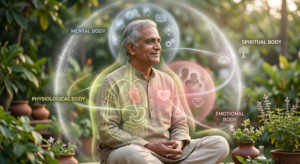
One of the most distinctive and powerful aspects of the Ayurvedic approach, as explained by Dr. Chaubey, is that it does not treat the human being as only a physical body.
Ayurveda recognises four interconnected bodies, each with its own needs especially after 60:
- The physiological body : the physical structure, organs, systems, and metabolic processes. This is what most modern health conversations focus on exclusively.
- The mental body : cognitive health, clarity, memory, and the mind’s ability to process and respond to the world.
- The emotional body : the felt experience of life: relationships, purpose, grief, joy, belonging, and psychological wellbeing.
- The spiritual body : the deeper sense of meaning, identity, and connection to something larger than the self.
If you only address the physiological body and ignore the other three, you will manage symptoms but never truly heal. This is especially true after 60, when all four bodies are undergoing significant transition simultaneously. A person navigating retirement, changing family dynamics, loss of peers, and shifting identity cannot be treated with nutrition alone though nutrition remains the essential foundation.
This is why Ayurvedic treatment protocols for seniors are not simply adjusted doses of the same interventions used for younger adults. They are holistically redesigned to honour all four dimensions of the person.
What Happens to Metabolism After 60 and Why Your Diet Must Change
In your 30s and 40s, your body is burning calories continuously through work, physical activity, exercise, and the simple metabolic demands of a highly active system. Your muscles are engaged. Your digestion is strong. Your body can take heavier foods, convert them efficiently, and use the energy quickly.
After 60, this changes in multiple ways. Physical energy expenditure drops substantially. Muscles are used less intensively. Digestion becomes more variable. The metabolic fire, what Ayurveda calls Agni; is no longer as strong or as consistent as it once was.
The consequence is significant: food that once gave you energy now gets stored. The same roti, the same portion of rice, the same heavy dal that fuelled you at 45 may now be contributing to visceral fat accumulation, higher triglycerides, sluggish digestion, and elevated blood sugar, simply because your body can no longer process it at the same speed or efficiency.
In youth, the focus should be on macronutrients, carbohydrates, proteins, and fats because the body needs fuel for continuous high-intensity energy expenditure. After 60, the focus must shift decisively toward micronutrients, the minerals, antioxidants, vitamins, and fiber that nourish at the cellular level, protect organs, and keep systems functioning cleanly even as overall metabolic rate slows.
This single insight the shift from macro to micro is the nutritional cornerstone of healthy aging in Ayurveda.
The 70-80% Vegetables and Fruits Rule? What It Means and How to Follow It
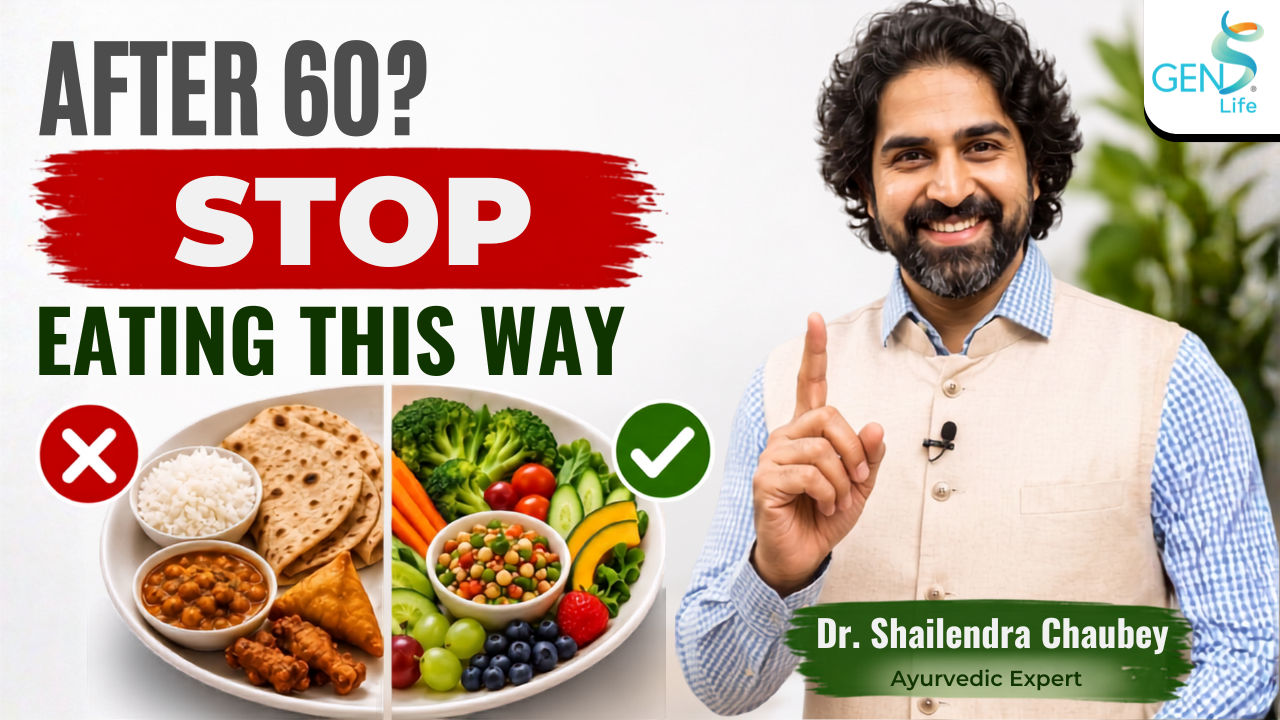
Vegetables and fruits should make up 70 to 80 percent of what you eat. Grains especially wheat and rice should be significantly reduced.
This is not a temporary detox or a restrictive diet plan. It is a fundamental reorientation of the plate to align with what the aging body actually needs.
Why vegetables and fruits?
They are the richest available sources of micronutrients, the antioxidants, minerals, vitamins, and fiber that the body needs at a cellular level after 60. Unlike grains, which are primarily energy-dense macronutrient sources, vegetables and fruits provide nourishment without excessive caloric load. They are lighter on digestion, easier to process with a slower Agni, and packed with the compounds that protect against exactly the conditions. High BP, high cholesterol, blood sugar dysregulation, inflammation that become more prevalent after 60.
The liveliness quotient. Vegetables and fruits that are fresh, minimally processed, and lightly cooked carry a high liveliness quotient a vital energy that nourishes cells in a way that heavily processed, overcooked, or preserved food simply cannot. This aligns with Ayurveda’s concept of Prana, the life force present in fresh, whole, natural food.
Why reduce grains?
Grains, particularly refined wheat and white rice are high glycemic load foods. In seniors with slower metabolism and reduced physical activity, high glycemic foods lead to rapid blood sugar spikes, contribute to insulin resistance, promote fat storage rather than energy use, and place additional burden on an already slower digestive system. Reducing grains is not about eliminating carbohydrates entirely. It is about choosing the right sources of carbohydrates for a body that no longer burns fuel the way it once did.
Cooking Methods Matter — Why Overheating and Heavy Spicing Are Harming Your Health
Dr. Chaubey raises a point that is frequently overlooked even by health-conscious seniors: how you cook your vegetables matters as much as which vegetables you eat.
Excessive heat: prolonged boiling, deep frying, pressure cooking beyond necessity destroys the delicate micronutrients in vegetables. The antioxidants, vitamins, and enzymes that make vegetables so valuable for senior health are heat-sensitive. Once destroyed in cooking, they cannot be recovered.
Similarly, excessive use of masalas heavy spice blends cooked at high temperatures in oil creates a chemical environment in the digestive tract that is counterproductive to the gentle, micronutrient-rich nourishment that aging bodies need.
Dr. Chaubey’s recommendation: opt for light steaming, brief sautéing, or minimal cooking that softens the vegetable while preserving its nutritional integrity. For vegetables where raw consumption is safe thoroughly washed salad vegetables, for example, raw or lightly blanched preparation is ideal.
He also notes that some vegetables are “sun-cooked” naturally ripened through exposure to sunlight and carry a natural vitality that is best preserved through minimal processing.
The principle is simple: cook lightly, season moderately, and let the natural nourishment of fresh vegetables do what it is designed to do.
Understanding Prakriti. Why Ayurveda’s Approach to Senior Health Is Deeply Personal
One of the most philosophically rich and practically important concepts Dr. Chaubey discusses is Prakriti, the Ayurvedic term for an individual’s unique natural constitution or blueprint.
Unlike modern nutrition science, which largely operates on population-level averages and generalised recommendations, Ayurveda begins with the individual. Every person is born with a unique Prakriti, a specific combination of the three doshas (Vata, Pitta, and Kapha) that determines how their body processes food, responds to stress, generates and uses energy, and is predisposed to certain health conditions.
Understanding your Prakriti is not an abstract spiritual exercise. It is deeply practical. It tells you:
- Which foods will nourish you and which will aggravate your constitution
- What kinds of exercise and activity are appropriate for your body type
- How your body will tend to respond to aging and what imbalances to watch for
- What herbs and supplements are most likely to benefit you specifically
Dr. Chaubey explains that the Ayurvedic approach to senior health is therefore always personalised. The dietary recommendations, herbal protocols, lifestyle adjustments, and healing regimes are designed around the individual’s Prakriti not applied uniformly to everyone who happens to be 65 years old.
This is why two seniors with the same diagnosis of hypertension may receive quite different Ayurvedic recommendations. The condition may be similar; the constitutional cause and the appropriate response may be entirely different.
Ayurvedic Herbs for Senior Health: What Dr. Chaubey Recommends
While the primary focus of Dr. Chaubey’s conversation is nutrition and diet, he briefly introduces several Ayurvedic herbs that play an important role in senior wellness with the promise of a deeper discussion to follow.
- Brahmi: widely used to support cognitive function, memory, and mental clarity. Particularly relevant for seniors experiencing age-related cognitive decline or wanting to maintain sharp mental function.
- Ashwagandha: one of Ayurveda’s most celebrated adaptogenic herbs, used to combat fatigue, support adrenal function, reduce stress, and improve overall vitality and stamina in aging adults.
- Guduchi (Giloy): a powerful immunomodulator that strengthens the immune system, reduces inflammation, and supports the body’s natural detoxification processes.
- Shatavari: traditionally used to support hormonal balance, digestive health, and vitality particularly relevant for senior women.
- Vidari: a rejuvenating herb used to support energy, strength, and the overall nourishment of tissues, classified in Ayurveda as a Rasayana (a rejuvenating tonic).
- Mansi: used to support nervous system health, sleep quality, and emotional balance.
Dr. Chaubey refers to these collectively as Rasayanas; natural rejuvenating tonics that support the body’s vitality and resilience as it ages. He notes that these herbs are not medicines in the conventional pharmaceutical sense. They are nourishing, tonifying agents that work with the body’s own healing intelligence rather than overriding it.
Practical Summary: Dr. Chaubey’s Key Dietary Recommendations for Seniors After 60
Shift your focus from macronutrients to micronutrients. Let cellular nourishment, not calorie-dense fuel, guide your food choices.
- Make vegetables and fruits 70 to 80 percent of your plate. Grains are no longer the foundation they are the minority.
- Reduce grains, especially wheat and white rice. If you eat rotis, make them predominantly from vegetables with only a small amount of binding flour.
- Prioritise fiber. Eat a wide variety of vegetables, fruits, and seeds daily for gut health, cholesterol management, and blood pressure regulation.
- Cook lightly. Steam, sauté briefly, or eat well-washed raw vegetables. Avoid overcooking and excessive spicing.
- Honour your Prakriti. Work with an Ayurvedic practitioner to understand your individual constitution and tailor your diet accordingly.
- Consider Ayurvedic Rasayanas. Herbs like Brahmi, Ashwagandha, Guduchi, and Shatavari can support vitality, immunity, and mental clarity in aging adults.
Do not make abrupt medication changes. These dietary principles support and may over time reduce medication dependence but always under the guidance of your physician.
Frequently Asked Questions
What should seniors eat after 60 according to Ayurveda? According to Dr. Shailendra Chaubey, seniors after 60 should focus primarily on micronutrient-rich foods, fresh vegetables, fruits, seeds, and fiber rather than grain-heavy meals. Vegetables and fruits should make up 70 to 80 percent of the diet, with grains like wheat and rice significantly reduced. Lightly cooked or minimally processed vegetables retain the most nutritional value for aging bodies.
Why does the body need a different diet after 60? After 60, the body’s metabolic rate slows significantly, physical energy expenditure decreases, and the digestive system becomes less efficient. Food that the body could easily convert to energy at 40 may now be stored as fat or contribute to conditions like high cholesterol, hypertension, and diabetes. This is why Ayurveda recommends a shift toward lighter, micronutrient-dense food after 60.
Can diet help control blood pressure naturally after 60? Yes. Dr. Shailendra Chaubey explains that a diet high in fiber, antioxidants, and micronutrients from fresh vegetables and fruits can meaningfully support blood pressure regulation. While medication should not be stopped abruptly, consistent adherence to Ayurvedic dietary principles can help seniors see gradual improvement in blood pressure readings over time, under medical supervision.
What is Prakriti in Ayurveda and how does it affect senior health? Prakriti is an individual’s unique natural constitution, a specific combination of the three doshas (Vata, Pitta, Kapha) determined at birth. In Ayurveda, all health and nutrition recommendations are personalised based on Prakriti. For seniors, understanding Prakriti helps identify which foods, herbs, and lifestyle practices are most appropriate for their specific body type and constitutional tendencies.
What Ayurvedic herbs are good for seniors? Dr. Shailendra Chaubey recommends several Ayurvedic herbs called Rasayanas for senior health: Brahmi for cognitive support, Ashwagandha for vitality and stress, Guduchi for immunity and inflammation, Shatavari for hormonal balance and digestion, Vidari for tissue nourishment, and Mansi for nervous system and sleep support.
What is the role of fiber in senior health? Fiber is one of the most important nutrients for seniors after 60. It supports gut health, regulates cholesterol by binding to LDL in the digestive tract, helps control blood sugar by slowing glucose absorption, reduces the risk of colorectal cancer, and maintains bowel regularity. Dr. Chaubey identifies fiber as the single most important nutrient for gut health and protection against several age-related conditions.
Is it safe to eat raw vegetables after 60? Yes, with proper preparation. Dr. Shailendra Chaubey recommends thoroughly washing vegetables to address concerns about germs and bacteria. Light steaming or brief sautéing is also excellent, as it softens the vegetable while preserving most of its nutritional content. The key is to avoid overcooking, which destroys heat-sensitive micronutrients and antioxidants.
What are macronutrients and micronutrients and which matters more after 60? Macronutrients are carbohydrates, proteins, and fats, the primary fuel sources needed in large quantities during youth and high-activity phases of life. Micronutrients are minerals, vitamins, antioxidants, and fiber needed in smaller quantities but critical for cellular function. After 60, with reduced energy expenditure, the focus should shift from macronutrients to micronutrients prioritising cellular nourishment over high-calorie fuel.
About Gen S Life
Gen S Life is India’s most vibrant platform for the 60+ generation a space built around vitality, wisdom, and purposeful living. Through expert-led conversations, live sessions, community events, and skill-building programmes, Gen S Life brings India’s seniors together to learn, connect, and thrive.
Stay connected, learn new skills, attend live sessions, join communities, and discover meaningful experiences with the Gen S Life App. Download the Gen S Life App and become part of India’s most engaging senior community.
Did Dr. Shailendra Chaubey’s insights change the way you think about your diet? Share this article with someone you care about. Drop your questions or experiences in the comments below, our community would love to hear from you.
Watch the full conversation with Dr. Shailendra Chaubey on the Gen S Life YouTube channel.