A heart attack and a cardiac arrest are not the same emergency, and some heart attacks give no warning at all. Interventional cardiologist Dr Ajit Menon explains the symptoms, the golden hour, silent heart attacks in diabetics, and why every housing society should learn CPR.
What is a heart attack, and what does it feel like?
A heart attack happens when the blood supply to the heart is cut off and part of the heart muscle dies. Dr Menon is direct about it: the muscle dies, and that is the damage.
The typical symptoms he lists:
- Severe tightness in the chest, like something heavy placed on it, that does not go away
- Pain or tightness that spreads to one or both arms
- Pain in one or both sides of the jaw
Some people feel only jaw pain. They often visit a dentist first, find nothing wrong, and only then reach a cardiologist. Dr Menon explains that the pain can sit anywhere between the angle of the jaw and the level of the navel, because the nerve supply of the heart and the skin follows the same distribution.
If you have these symptoms, get an ECG done.
The golden hour: why timing saves heart muscle
The earlier a heart attack is treated, the more muscle is saved. Dr Menon calls the first hour after a heart attack the golden hour. In his words, if a heart attack is treated within that first hour, the muscle in all probability will not be damaged, and a lot of muscle injury is avoided.
- First hour: the best chance of escaping muscle damage
- First three hours: still extremely crucial, and a good result is still possible
- After that: the longer you wait, the more the heart muscle is damaged, and damaged heart muscle does not recover
This is the reason he asks people with these symptoms to get an ECG straight away instead of waiting to see if the pain passes.
What is a silent heart attack?
A silent heart attack is one that the person does not recognise as a heart attack. Dr Menon says this typically happens in severely diabetic patients, because diabetes can damage the nerves that carry pain.
These patients may have no chest pain and no pain in the arm or jaw. They may feel only some uneasiness, or what they take to be acidity, and it goes away. In a few patients the heart attack goes completely unnoticed. Months later, a routine ECG or echo comes back abnormal, and that is how they find out.
Why this matters: a heart attack with warning symptoms gives you time to treat it. A silent one means the muscle has already been lost, the heart’s pumping drops, and it can lead to heart failure.
If you are diabetic, do not dismiss unexplained uneasiness as acidity every time, and keep up with routine heart check-ups.
Heart attack vs cardiac arrest: what is the difference?
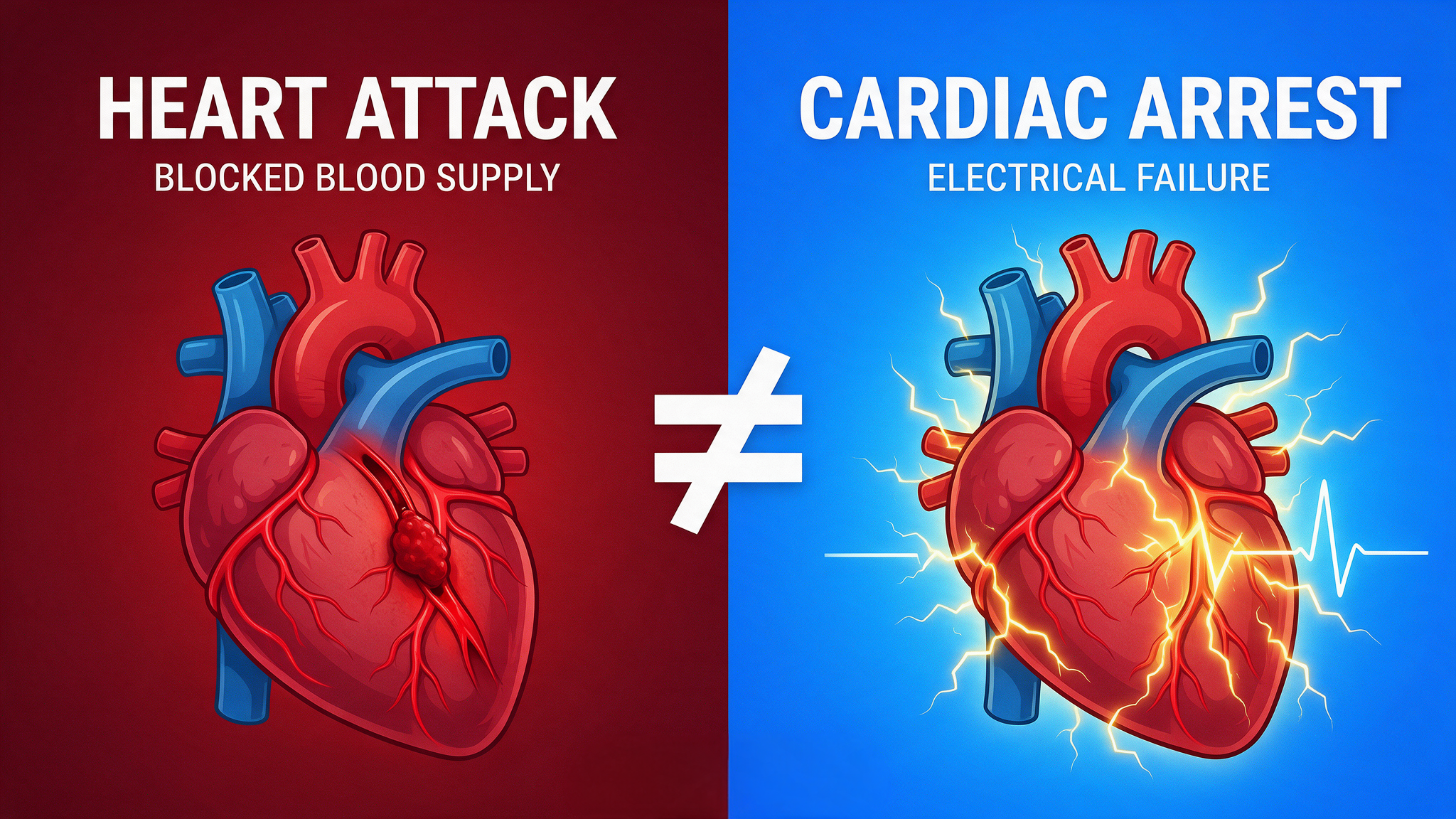
A heart attack is a blood supply problem. A cardiac arrest is an electrical problem. Dr Menon compares it to a house: in a heart attack the supply to part of the house is compromised, while in a cardiac arrest the whole area goes into an electrical shutdown.
| Heart attack | Cardiac arrest | |
|---|---|---|
| Cause | Blood supply to the heart is blocked | The heart’s electrical system fails |
| What happens | Heart muscle dies | The lower heart beats very fast and irregularly (ventricular tachycardia), then quivers (fibrillation), and pumping stops |
| How it looks | Chest tightness, pain in arms or jaw; the patient is usually conscious | No pulse, no movement |
| First response | Get an ECG and reach hospital quickly | Start CPR and give a shock if a defibrillator is available |
A heart attack can lead to a cardiac arrest. An irritable, damaged heart muscle can push the rhythm too fast, and the heart can stop. But a cardiac arrest does not always follow a heart attack: some rhythm abnormalities and heart muscle conditions can cause one too.
One point Dr Menon stresses: a shock is for cardiac arrest. If someone has a heart attack and is awake with pain, do not shock them.
CPR and defibrillators: why your housing society should be ready
In a cardiac arrest, a shock to the heart brings the rhythm back to normal in most cases of ventricular tachycardia or fibrillation. That is why Dr Menon encourages housing societies, especially those with elderly residents, to install a defibrillator.
- One portable defibrillator can serve roughly five or six buildings, because it can be carried to the patient
- Teams are available who will come and train a society on how to give CPR and how to use the shock
- If someone has no pulse and no movement, start CPR and give a shock
Time is the deciding factor. The chance of survival drops with every passing minute, and starting CPR within the first few minutes gives the patient a much higher chance.
Dr Menon points to cities in the US such as Seattle, where almost everyone is trained in CPR and survival after a cardiac arrest outside hospital depends on how soon CPR begins. In India, he says, bystanders typically stand and watch. His message: train societies and individuals in CPR, and many lives will be saved.
Frequently asked questions
Can you have a heart attack and not know it? Yes. Some severely diabetic patients, whose nerves are damaged, may feel only mild uneasiness or acidity, or nothing. It is often found later on a routine ECG or echo.
Is a heart attack the same as a cardiac arrest? No. A heart attack is a blocked blood supply that kills heart muscle. A cardiac arrest is an electrical failure that makes the heart stop pumping.
What is the golden hour in a heart attack? The first hour after a heart attack. Treatment in this window gives the best chance of saving heart muscle. The first three hours are still crucial.
Should I shock someone who has a heart attack? No. A shock is for cardiac arrest, when the person has no pulse and no movement. Start CPR and use a defibrillator in that case.
Why should a housing society have a defibrillator? Because survival in cardiac arrest depends on how quickly CPR and a shock are given. One portable unit can cover several buildings, and trained residents can act in the first minutes.
This article summarises a conversation with Dr Ajit Menon and is for general awareness. It is not medical advice. If you or someone near you has chest pain or collapses, call emergency services immediately.