
For most retirees, the hardest financial question isn’t how much you’ve saved. It’s how to make that fixed pile of money pay you a reliable income every month, without taking risks you can’t afford and without the pot running dry. The good news in 2026 is that safe, government-backed options are still paying some of their best rates in years. The catch is that the window may be starting to close, which makes how you arrange things right now matter more than usual.
Here is a clear, current map of your choices: what each one pays, how they’re taxed, how to combine them, and worked examples for real situations.
Why the timing matters this year

Interest rates move in cycles, and the cycle has turned. The Reserve Bank of India cut its repo rate to 5.25% in April 2026 after a series of reductions through 2025. Small-savings rates tend to follow the same direction with a lag, so the generous rates on offer today are more likely to drift down than up over the next couple of years.
That points to a simple advantage worth understanding: several of the best senior schemes lock in your rate for the full term on the day you open the account. If you open a Senior Citizen Savings Scheme account today, your 8.2% is fixed for five years even if the government trims the rate next quarter. Acting while rates are high can protect your income for years.
The four safe options at a glance
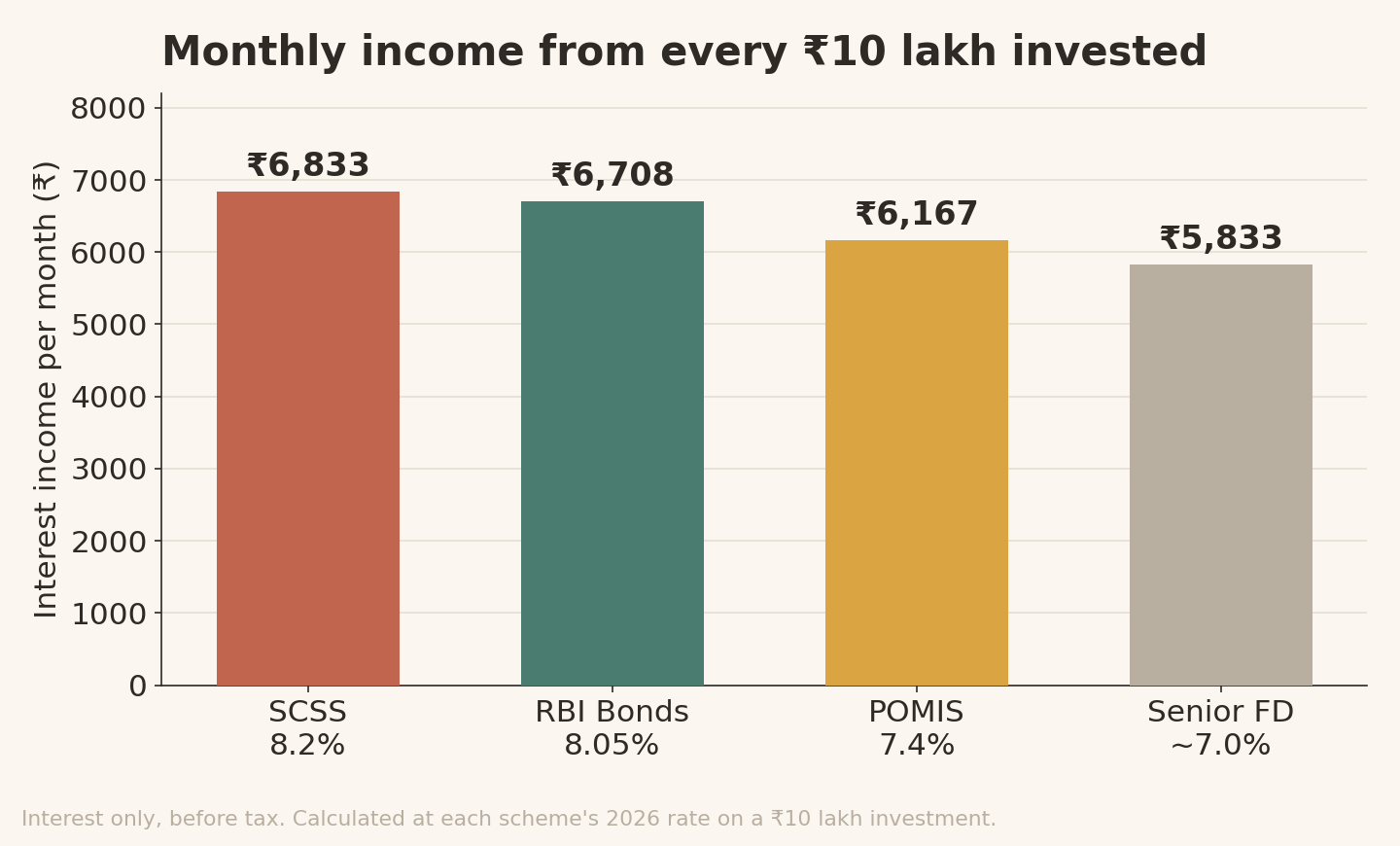
| Scheme | Rate (2026) | Interest paid | Maximum you can invest | Term |
|---|---|---|---|---|
| Senior Citizen Savings Scheme (SCSS) | 8.2% | Every quarter | ₹30 lakh per person | 5 years (+3) |
| RBI Floating Rate Savings Bonds | 8.05% (floats) | Every 6 months | No upper limit | 7 years |
| Post Office Monthly Income Scheme (POMIS) | 7.4% | Every month | ₹9 lakh single / ₹15 lakh joint | 5 years |
| Senior citizen bank FD | around 7.0% (varies) | Your choice | No limit (₹5 lakh insured) | You choose |
The four building blocks, explained
Senior Citizen Savings Scheme (SCSS): the anchor. This is the highest-paying government-guaranteed option available to retirees. It pays 8.2% a year, credited quarterly straight to your bank account, and that rate has held steady since April 2023. You can invest up to ₹30 lakh per person, so a husband and wife who are both 60 or older can hold ₹30 lakh each in separate accounts, for ₹60 lakh between them. The amount you invest in the year you open the account qualifies for a deduction of up to ₹1.5 lakh under Section 80C, but only if you stay on the old tax regime. The interest itself is fully taxable.
Post Office Monthly Income Scheme (POMIS): for genuine monthly cash flow. SCSS pays every quarter, but household bills come every month, and that’s where POMIS fits. It pays 7.4% a year, credited monthly, with a limit of ₹9 lakh in a single account and ₹15 lakh in a joint one. A ₹9 lakh holding generates roughly ₹5,550 a month, and a ₹15 lakh joint holding produces about ₹9,250 a month. There’s no 80C benefit here, and the interest is taxable, but for smoothing out month-to-month spending it does one job well.
RBI Floating Rate Savings Bonds: for money beyond the SCSS ceiling. Once you’ve used up your SCSS limit, these government bonds are often the next stop. They pay 8.05% for the July to December 2026 period, credited every six months. The rate isn’t fixed: it is set at the National Savings Certificate rate plus 0.35%, and it resets every six months, so your income can move up or down. There’s no upper investment limit and a sovereign guarantee behind it, but the term is seven years and the interest is fully taxable with no 80C deduction. Seniors get early-exit rights others don’t: those aged 60 to 70 can exit after six years, 70 to 80 after five, and 80 and above after four.
Senior citizen fixed deposits: for flexibility. Bank FDs usually pay retirees around half a percentage point more than the standard rate, and they let you pick your own tenure, which the government schemes don’t. The trade-off is that bank deposits are insured only up to ₹5 lakh per bank under DICGC, whereas the post office and government schemes carry a full sovereign guarantee on the entire amount. If you keep a large sum in FDs, spreading it across banks keeps more of it inside that insurance limit.
What this actually means in rupees
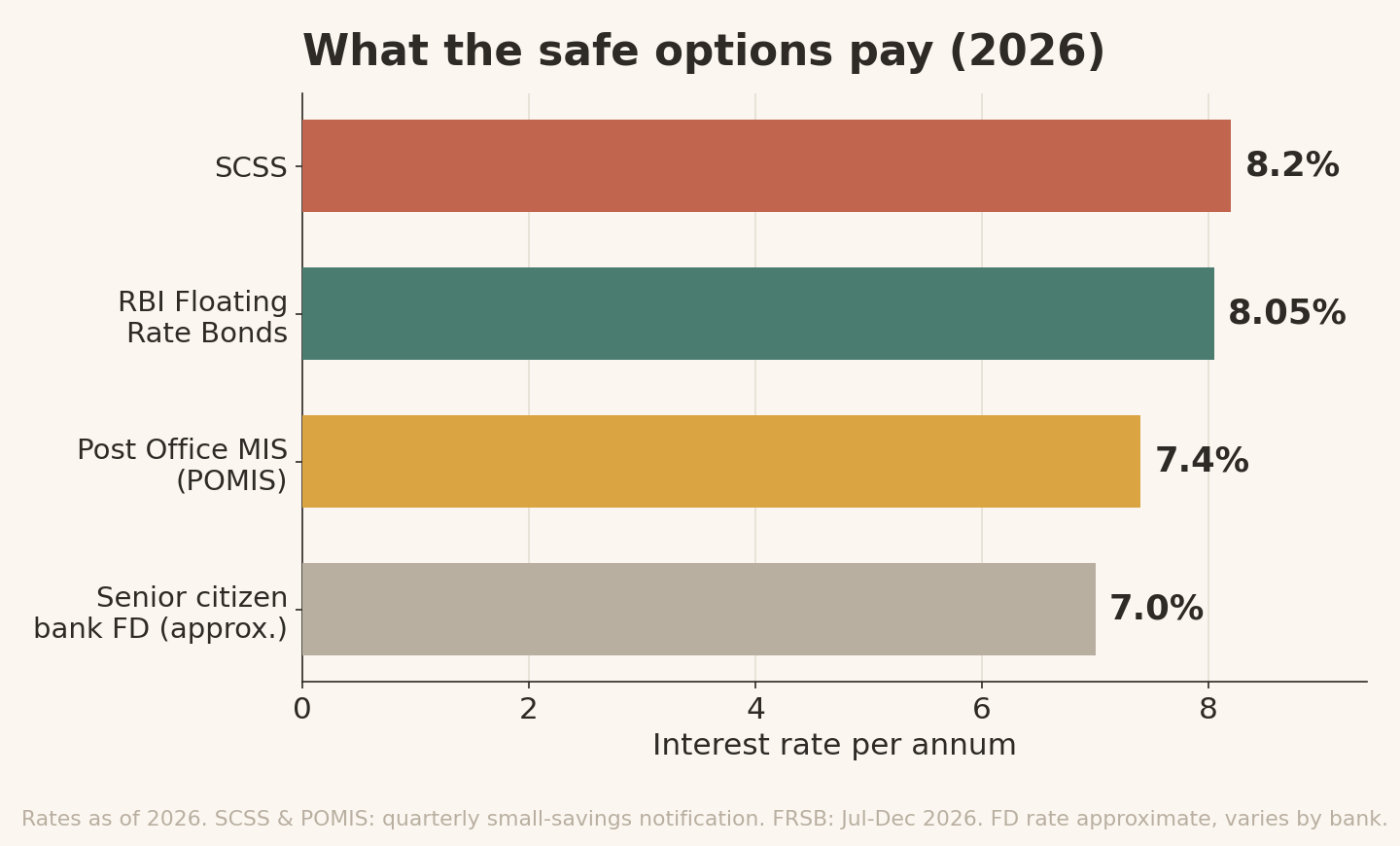
The rate matters less than the money it puts in your hand. Here is the monthly interest each option produces for every ₹10 lakh you invest, before tax.
And here is how SCSS income scales as the amount grows, since it will usually be the centrepiece:
| Amount in SCSS | Yearly interest (8.2%) | Roughly per month |
|---|---|---|
| ₹10 lakh | ₹82,000 | ₹6,833 |
| ₹20 lakh | ₹1,64,000 | ₹13,667 |
| ₹30 lakh | ₹2,46,000 | ₹20,500 |
| ₹60 lakh (couple, two accounts) | ₹4,92,000 | ₹41,000 |
Three situations, three plans
Priya, 63, retired teacher, ₹20 lakh, lives alone. She wants the steadiest possible monthly income and total safety. A clean split is ₹9 lakh in POMIS for a monthly cheque of about ₹5,550, and the remaining ₹11 lakh in SCSS at 8.2%, which adds roughly ₹7,500 a month in quarterly instalments. Together that is close to ₹13,000 a month, fully government-backed, with her capital intact.

The Sharmas, both 65, ₹60 lakh, want maximum safe income. Because each spouse has their own ₹30 lakh SCSS limit, they open two SCSS accounts of ₹30 lakh each. That single move locks in 8.2% on the whole corpus and generates about ₹4.92 lakh a year, or ₹41,000 a month, split across the two accounts’ quarterly payouts. If they want some of it reaching them monthly instead, they can move ₹9 lakh of one spouse’s share into POMIS.

Mr. Rao, 68, ₹1 crore, wants income beyond the SCSS cap. SCSS alone can’t absorb it all, so he layers the options. He puts ₹30 lakh in SCSS, ₹9 lakh in POMIS for monthly flow, and ₹40 lakh in RBI Floating Rate Bonds at 8.05%. The final ₹21 lakh he splits between a couple of senior citizen FDs for flexibility and a small Systematic Withdrawal Plan from a mutual fund, so a slice of the corpus keeps growing against inflation. His guaranteed layer covers the essentials, and the growth layer defends his future purchasing power.

The tax picture is friendlier than most retirees think
The headline worry with all of these is that the interest is taxable. In practice, many retirees pay little or nothing, because of provisions written specifically for them.

Section 80TTB lets a resident senior deduct up to ₹50,000 a year of interest earned from deposits with banks, post offices, and co-operative banks. This covers SCSS, POMIS, and FD interest, though not the RBI bonds, which count as a security rather than a deposit.
There’s also relief on the paperwork. The threshold at which tax is deducted at source on interest, under Section 194A, was raised in Budget 2025 to ₹1 lakh for senior citizens, up from ₹50,000. If your income sits below the taxable limit, filing Form 15H with your bank or post office stops TDS being deducted in the first place, so you aren’t left waiting for a refund.
The bigger shift is in the slabs. Under the new tax regime for 2025-26, the basic exemption is ₹4 lakh, and the Section 87A rebate goes up to ₹60,000 for total income up to ₹12 lakh. In plain terms, a retiree whose total income stays within ₹12 lakh may owe no income tax at all under the new regime. Whether the old regime, with its 80C and 80TTB deductions, or the new one works out better depends on your numbers, so it is worth running both. Our guide to the rights and tax benefits of senior citizens in India goes deeper on what else you’re entitled to.
The one risk fixed income doesn’t cover
Guaranteed schemes protect your capital, but not its purchasing power. A rate of 8.2% looks comfortable until you remember that the costs which hit retirees hardest, like healthcare, medicines, and food, often climb faster than the headline inflation figure. Money that only ever earns a fixed rate slowly buys less each year.

This is why many planners suggest keeping the bulk of your corpus in these safe income schemes while letting a smaller slice pursue growth that can outpace inflation. A common route is a Systematic Withdrawal Plan from a mutual fund, which lets you draw a set amount each month while the rest stays invested. We cover how that works, and how it’s taxed, in What is SWP in Mutual Funds. It pairs with the guaranteed schemes above rather than replacing them.
A simple way to start

You don’t have to decide everything at once. Cover your essential monthly expenses with guaranteed income first, using SCSS as the anchor and POMIS for the monthly rhythm, then decide what to do with whatever is left. Lock in the high fixed rates while they’re on offer, keep some money reachable for emergencies, and give a modest portion room to grow. For a broader toolkit, see our roundup of the best retirement planning tools in India.
Frequently asked questions
Which is better, SCSS or POMIS? For most seniors, SCSS wins on rate (8.2% versus 7.4%) and on limit (₹30 lakh versus ₹9 lakh). POMIS earns its place for one reason: it pays every month, while SCSS pays every quarter. Many retirees use both, SCSS for the higher return and POMIS for monthly cash flow.
Can I invest in more than one scheme at the same time? Yes. You can hold SCSS, POMIS, RBI bonds, and FDs together, each up to its own limit. Layering them is exactly how retirees build a mix of quarterly, monthly, and half-yearly income.
Can my spouse and I each open our own SCSS account? Yes, if both of you are eligible. Each person has a separate ₹30 lakh limit, so a couple can hold up to ₹60 lakh in SCSS across two accounts.
Is the interest tax-free? No. Interest from all four options is taxable. But Section 80TTB (up to ₹50,000 on deposit interest), the higher TDS threshold for seniors, and the new-regime rebate mean many retirees pay little or no tax in practice.
What happens when SCSS rates fall after I’ve invested? Nothing to your account. The rate is locked on the day you open it and stays fixed for the full five-year term, which is why opening while rates are high is an advantage.
How do I stop tax being deducted if my income is below the limit? Submit Form 15H to the bank or post office holding your account. It tells them your total income is below the taxable threshold, so they don’t deduct TDS.
Is my money actually safe? The government schemes (SCSS, POMIS, RBI bonds) carry a sovereign guarantee on the full amount. Bank FDs are insured up to ₹5 lakh per bank, so spread larger sums across banks.

Related reading
For more on stretching a retirement corpus, tax, and family money decisions, browse the Gen S Life finance section, read why Indian families avoid talking about money, or keep these tools in your pocket with the Gen S Life app.
This article is for general information only and is not financial, tax, or investment advice. Interest rates, limits, and tax rules change and vary by individual circumstances. Please confirm current figures and consult a qualified financial advisor or chartered accountant before making any investment decision.