
There was a time when catching a criminal was simple. He had a face. He had a method. The police could trace him through his modus operandi: the way he broke in, the way he ran.
That criminal is gone. In his place is someone far harder to catch: the cybercriminal has no face. He hides behind IP cloaks, cloned accounts, and borrowed identities, and in Maharashtra alone, he is committing a crime every 15 minutes.
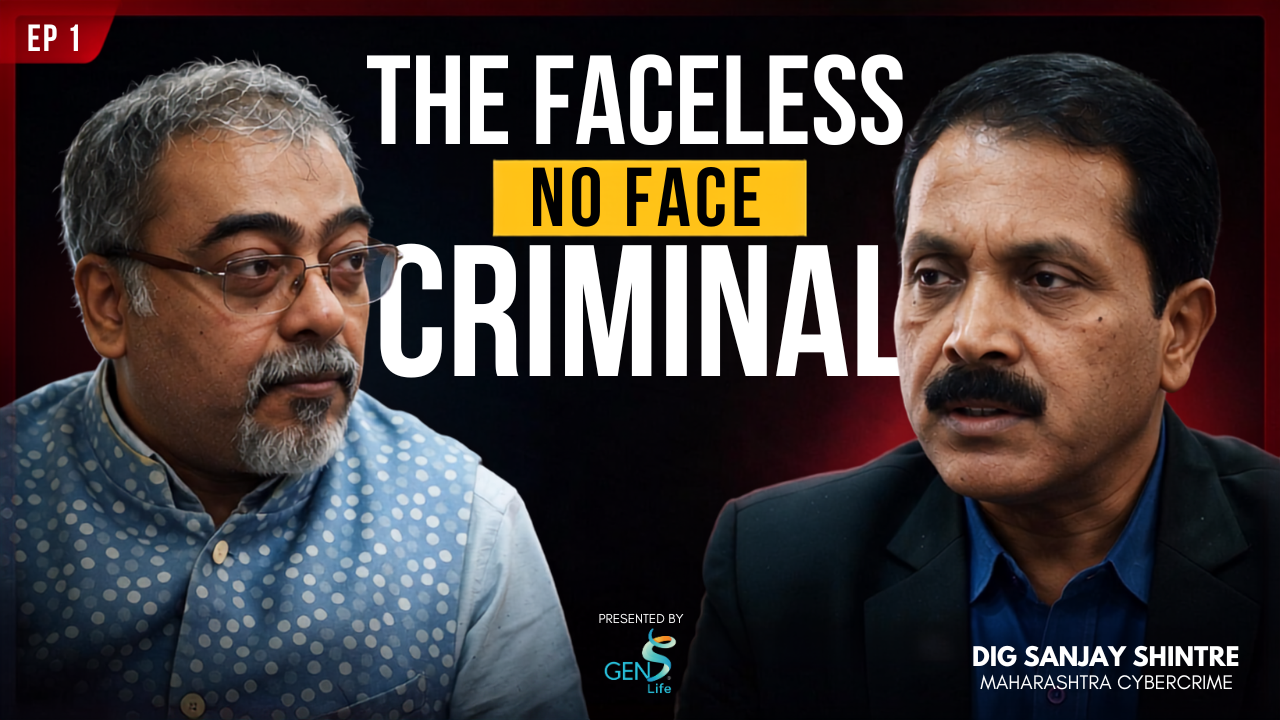
In Part 1 of our special series, true-crime author and Savdhan India creator Anirban Bhattacharya sits down with Sanjay Shintre, DIG of the Maharashtra Cybercrime Department, to unpack exactly how, and why, senior citizens have become this new villain’s favorite target.
The Numbers Are Staggering, and Growing
This isn’t a fringe problem. It’s one of the fastest-growing crime categories in the country:
- Maharashtra registered 10,505 cyber fraud cases between January 2025 and May 2026, resulting in 2,379 arrests, Chief Minister Devendra Fadnavis told the state Assembly ().
- Mumbai alone recorded 4,825 cyber financial fraud cases in 2025, with losses of ₹1,031 crore ().
- Nationally, cybercrime complaints rose 24% in 2025, with a total of ₹22,495 crore lost to fraud ().
That last figure lines up almost exactly with what DIG Shintre says in the interview: that Maharashtra alone sees close to 5,000 cybercrime complaints every single day, or roughly four every minute.
Senior Citizens: The Fastest-Growing Target
Here’s the number that should worry every family with aging parents. In 2025, 1,03,488 senior citizens filed cyber fraud complaints, losing a combined ₹4,005.12 crore, reported by the Ministry of Home Affairs in a written reply to the Rajya Sabha (; ).
Women reported a similar pattern (4,63,114 complaints and ₹3,764.51 crore lost), but seniors are uniquely vulnerable for a reason DIG Shintre lays out plainly in the interview:
“These senior citizens have very low knowledge about this digital technology. Whatever the software, the hardware, whatever the electronic devices the youth are using or even children are using, that knowledge is not with these elderly persons… And the cybercriminals are targeting them because they have some assets, they have some liquid money in banks, and they don’t have any technological knowledge about these electronic devices, mobile phones, laptops, all types of IoT devices also.”
He also points to something less obvious than a lack of tech skills: loneliness. As India’s elderly population grows toward 230 million by 2036 (), more seniors are living alone or feeling disconnected from family, and that isolation is exactly what makes them easier to manipulate, and slower to have a second opinion before sending money.
The Scam You Need to Know About Right Now: “Digital Arrest”
One tactic DIG Shintre’s department is actively fighting is the “digital arrest” scam, and it’s worth explaining in full, because it’s brutally effective on seniors specifically.
Here’s how it works: a fraudster calls or video-calls the victim, impersonating a CBI, customs, or police officer. They claim the victim (or their child) is under investigation for something serious, like drug trafficking or money laundering, and that they are now under “digital arrest” and cannot leave their home or hang up until they pay a fine or “cooperate” with the investigation.
There is no such thing as a “digital arrest” under Indian law. Any call claiming otherwise is a scam, full stop ().
It works because it borrows real fear (fear of the police, fear of shaming the family) and applies it under time pressure, before the victim can call anyone else to check. In one recent case, a Gujarat senior citizen was kept under a 28-day digital arrest scam and defrauded of ₹1.47 crore (). CM Fadnavis has personally urged citizens to report any such call immediately to the 1930 helpline ().
If this happens to you or someone you love:
- Hang up. Real law enforcement does not conduct arrests over video call.
- Do not transfer money or share OTPs, no matter how official the caller sounds.
- Call the national cybercrime helpline, 1930, or report it at , immediately. Speed matters: the faster a fraud is reported, the higher the chance the money can still be traced and frozen.
What This Means for Your Family
DIG Shintre’s message, stripped down, is this: senior citizens aren’t targeted because they’re careless; they’re targeted because they have money, and no one has walked them through how today’s frauds actually work.
That’s a gap families can close in one conversation. Talk to your parents about:
- Never sharing OTPs, PINs, or bank details over a call, SMS, or WhatsApp message. No bank or government office will ever ask for these.
- The fact that “digital arrest” isn’t real, and neither are threats of “your account will be frozen in 10 minutes.”
- Saving the 1930 helpline number directly into their phone contacts, so it’s one tap away if something feels wrong.
Watch the Full Interview: Part 1
This is Part 1 of a special multi-part series with the Maharashtra Cybercrime Department. In the next installment, DIG Shintre goes deeper into exactly how senior citizens can protect themselves: practical, specific steps straight from the officer leading the fight.
Related on Gen S Life
- : an earlier deep-dive with DIG Shintre on the most common scams targeting seniors.
- : our first conversation with the Maharashtra Cyber Cell.
- : what legal protections exist if you’re targeted.
- : because protecting your savings starts before the scam call ever comes.
Want more conversations like this one? , a platform built on seniors and families looking out for each other.